Part of the SI Law family of independent guides 🎨 Appearance · Unofficial — read the disclaimer

For prospective students

Thinking about law school? Start here.

Admissions interview prep with question banks and mock interviews, plain-language guides to what the bar actually tests, state-by-state bar guides so you can compare jurisdictions, and a profile that keeps the schools you’re considering in one place. The same platform — and the same free trial — carries you from applicant to attorney.

$7.99/month after a free 7-day trial. Start with 40 free questions and every guide — free account, no card. Compare plans.
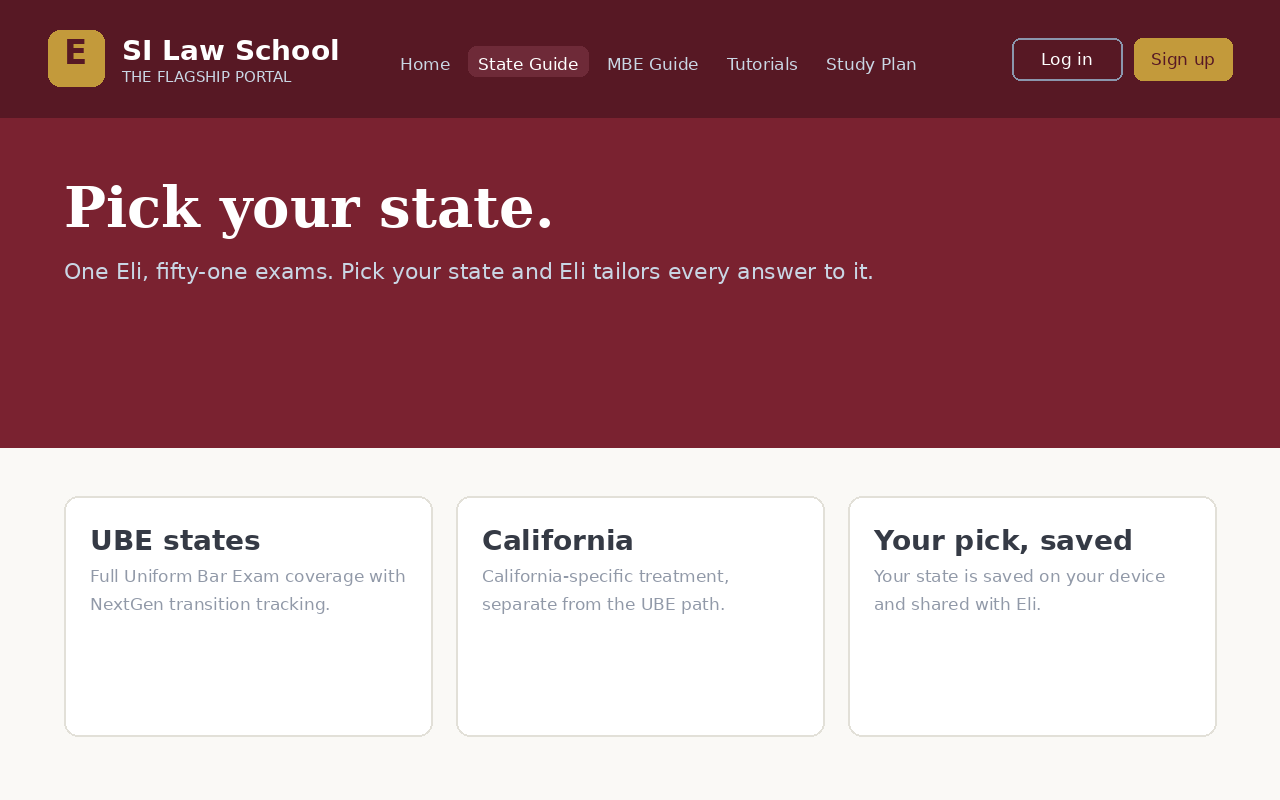
Screenshot of the state-by-state bar exam guide
State bar guide. UBE vs. non-UBE, California to New York, in depth.
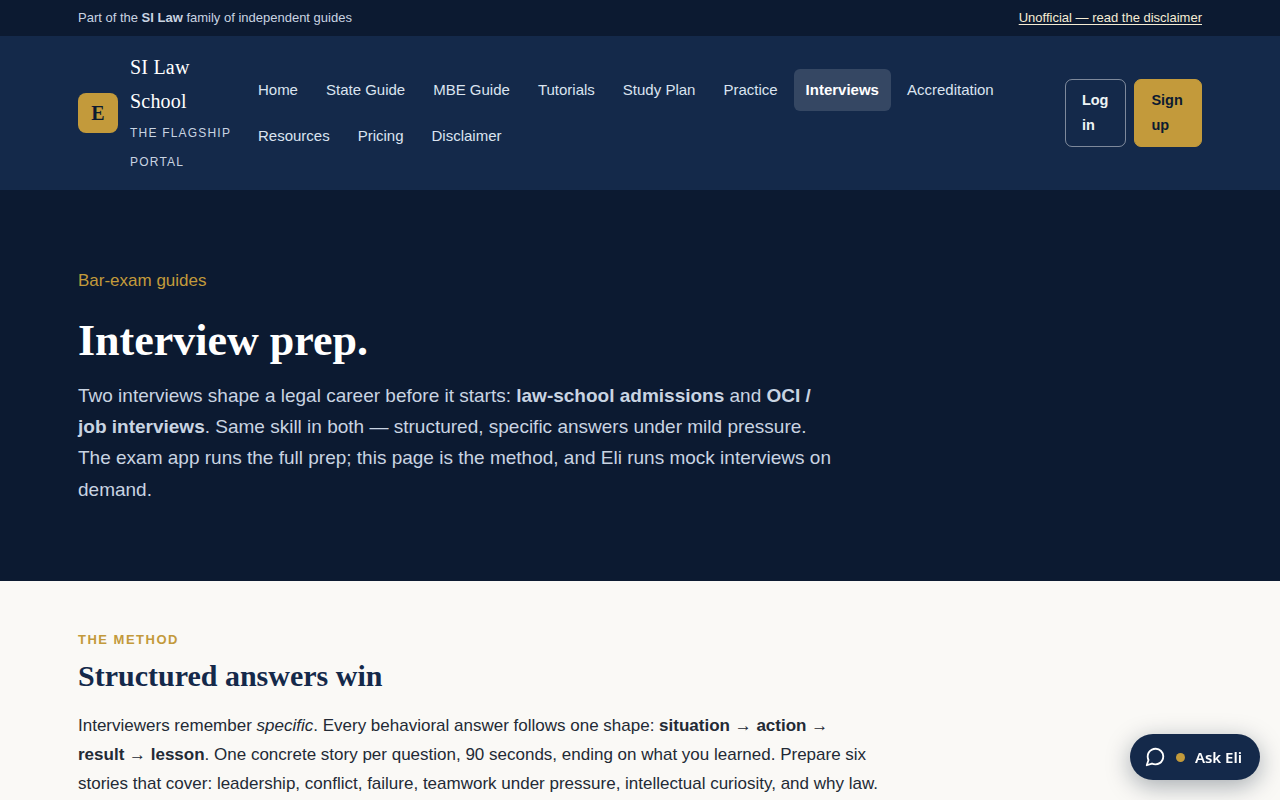
Screenshot of the law-school interview prep page
Interview prep. Admissions question banks and Eli mock interviews.
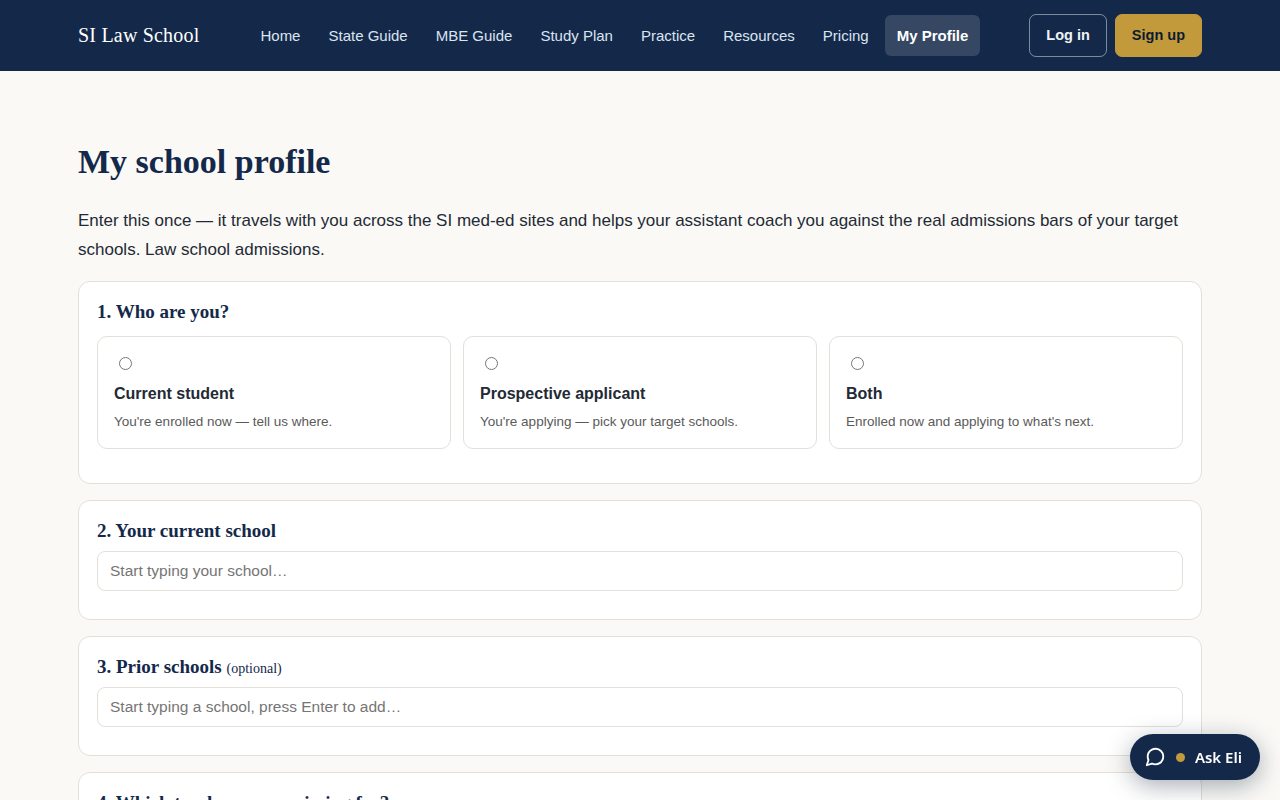
Screenshot of the My Profile page for tracking schools
Your profile. The schools you’re considering, kept in one place.

Watch: the prospective-student walkthrough (70 seconds)

Try law school on for size

See what law school feels like \u2014 argue your first case.

No experience needed: pick a beginner-friendly motion about an everyday situation, and Eli coaches you step by step \u2014 what's your claim, what's your reason, what rule backs you up \u2014 then you deliver your first real argument by voice (or by typing). It's the closest thing to sitting in a 1L classroom, and it runs entirely in your browser.

Applying to law school

Know what you're walking into.

Admissions isn't a black box — it's a process with published rules, published timelines, and published outcomes. Every number below comes from an authoritative source: ABA disclosures, NALP reports, and NCBE data. Where we add our own read on what it means for you, we label it as ours.

What law schools look for. How admissions offices actually read your file — and what moves the needle.
Application timeline. Month by month, from LSAT prep through seat deposits.
Employment outcomes. Where graduates actually work, grounded in ABA and NALP data.
Bar passage by school. First-time bar results, so you can compare programs on outcomes.

Before you start

Get ready for your 1L year.

Your first year of law school has a shape — the same six courses, the same classroom ritual, the same exam style, at nearly every American law school. Start learning the shape of it now, so your first semester feels like a second language you’re already studying instead of a code nobody gave you.

What to expect your 1L year. The full guide: your six courses, the Socratic classroom, and how law exams actually work.
How to brief a case. The reading skill every 1L learns the hard way — learn it the easy way.
IRAC primer. Issue, Rule, Application, Conclusion — the writing structure behind every good exam answer.
Cases to know before 1L. The landmark cases your professors will assume you’ve heard of.
0L summer schedule builder. Build a low-pressure pre-matriculation study plan for the summer before you start.
1L foundations practice. Untimed practice questions on the core first-year subjects.

The admissions test

Get ready for the LSAT.

The LSAT doesn't test what you know — it tests how you think. Learn the format, master argument anatomy and every question type, build a study plan that fits your timeline, and drill 1,010 original practice questions — all untimed until you're ready for the clock.

How the LSAT works. The current format, scoring, the writing sample, and what law schools do with your score — every fact from LSAC.
LSAT primer. Argument anatomy, every Logical Reasoning question type in plain language, and Reading Comprehension strategies.
How to study for the LSAT. The untimed-to-timed method, how to review wrong answers, pacing strategy, and test-day prep.
LSAT schedule builder. Build a week-by-week study plan from the weeks and hours you actually have.
8- and 12-week study plans. Phase-by-phase plans with weekly checkpoints, official practice-test points, and a taper week.
LSAT practice. 1,010 original questions by section, question type, and difficulty — untimed, with plain-language explanations.
LSAT flashcards. Daily reps: question types, common flaws, reading strategies, and key terminology.